
I Taught My Ice Bath to Read the Weather Forecast So It Would Be Cold at 5:30am. Then I Put a Tent on It.
My ice bath had a chiller, a thermostat, solar power and a target of 4°C. It had never been below 5.2°C in its life, and most mornings it sat at a refreshing 12. A year of data later, it turns out the chiller was fine. It was losing a fight with the sun, a concrete slab and a thin black lid. Here's the model, the 5:30am forecast it runs on now (full config included), and the second-hand camping tent that ended up outperforming the lot of it. Updated with three days of metered results: 7.0°C.
The ice bath and I have not been on speaking terms for most of this year.
Life got busy, as it does, and the thing I bought to make me a better, calmer, more disciplined father became the thing I walked past on the way to the bins. It sat in the corner of the patio being a large black inflatable tub of mildly cool water, humming to itself.
This week I decided we were getting back together. Every morning, 5:30am, in. No negotiating.
There was just one problem. Every morning at 5:30am, it was about 12°C.
For context: an ice bath at 12°C is not an ice bath. It's a bath. It's the temperature of a council swimming pool in October. You do not emerge from 12°C water reborn. You emerge from it slightly damp and faintly disappointed, which I can manage without any equipment at all.
The setup, and the crime scene
The hardware is simple. An inflatable black PVC tub. A matching black PVC lid. A small chiller, the kind that looks like a bar fridge had a baby with a toolbox, plus a little circulation pump. Both plugged into Zigbee smart plugs so Home Assistant can boss them around. A waterproof temperature probe in the water.
Last week I'd already torn out the original automations, which I wrote myself, at some point in the past, apparently while asleep. One of them checked whether the target was above the bath, which is the right idea pointed the wrong way. One turned the chiller on and then, a few lines later, off again, which is efficient in the sense that it used no power at all. One was meant to run the chiller on spare solar, and watched the house's lifetime energy total instead of its live power, so it only ever fired when a meter ticked over.
Reader, it is me. I am the bug.
The replacement was sensible: chill on spare solar during the day, give way to the car if it's charging, and top up overnight on the super-cheap midnight-to-6am rate. Never touch expensive grid power. It works exactly as designed.
The design just couldn't win.
A year of data and one rude awakening
Home Assistant forgets things after about ten days. Luckily everything also goes into a long-term database, so I had a full year: every temperature reading, every watt the chiller drew, every degree of outside air, every watt of solar. I shipped the lot to a little server I keep for number-crunching and asked it some pointed questions.
The answers, in order of how much they hurt:
The chiller is small. It draws about 300 watts. Not 700, which is the number I'd guessed when I set "start chilling when we're exporting this much solar", so for a week it had been politely waiting for a surplus more than double what it needed. Easy fix. Embarrassing fix.
Last December it ran for 566 hours. That's eighteen hours a day, every day, for a month. It wasn't lazy. It was drowning.
The bath leaks heat like a sieve. For every degree the air is warmer than the water, the bath warms up by about 0.03°C an hour. Doesn't sound like much. But hold the water at 8°C on a 28°C afternoon and that's a 20-degree gap, so 0.6°C an hour pouring in, which is about everything the chiller can pull out. It's not cooling. It's treading water.
The afternoon sun makes it worse. The tub lives under the patio roof, but in the afternoon the sun comes in low from the open side and lands on a black tub with a black lid. Afternoon heat gain per degree of temperature difference was about a third higher than in the morning. I have, at great expense, built a solar water heater and plumbed a fridge into it.
And the overnight run maxes out at about 6 degrees. The cheap window is six hours long, and the chiller pulls the water down at roughly a degree an hour, slowing as it gets colder. So the daily routine looked like this: chill overnight from 18°C down to about 12, stop at 6am, and warm back up all day to 18 by midnight. Repeat forever. A very expensive sawtooth.
The 4°C problem
At some point, in a burst of optimism, I'd set the target to 4°C.
Here's the coldest the bath can physically get with the chiller running flat out, no breaks, according to a year of my own data:
| Outside air | Coldest the bath can get |
|---|---|
| 20°C | about 5°C |
| 24°C | about 8°C |
| 28°C | about 11°C |
| 32°C | about 13.5°C |
It has never once been below 5.2°C. In Brisbane, in November, 4°C is a rumour.
And because the target could never be reached, the thermostat could never be satisfied, so the chiller ran every single minute it was allowed to, including hot afternoons where it was doing almost nothing. Yesterday, between 11am and 2pm, in 35°C air, it used about a kilowatt-hour to cool the bath by about 0.2 of a degree.
A thermostat set to a number it can't reach isn't a thermostat. It's an "on" switch with ambition.
Target's now 8°C. Achievable. Still deeply unpleasant. Perfect.
When is chilling actually efficient?
This is the bit where I expected to be clever, and got corrected by arithmetic instead.
A chiller is a heat pump running backwards. It works best when the water is warm and the air around it is cool, and worst when the water is cold and the air is hot. So per kilowatt-hour, the chiller does roughly three times as much cooling overnight as it does on a hot afternoon. Night is cool, the bath's at its warmest after a day of baking, and the power's 8c. Overnight is the workhorse.
So obviously, I thought, block the afternoons. Stop wasting power fighting the sun.
Then I did the sums on what the power actually costs.
The afternoon runs only use spare solar. If the chiller didn't use it, I'd export it to the grid for a feed-in tariff of 2 cents a kilowatt-hour. So even at its worst afternoon efficiency, a degree of cooling on solar costs me about 1.5 cents. A degree overnight, at 8c a kilowatt-hour, costs about 1.8 cents.
The inefficient afternoon is cheaper per degree than the efficient night. And the night window can only manage about 6 degrees anyway, so every degree knocked off during the day is one the night doesn't have to find. Blocking the afternoons would have made the bath warmer at 5:30am to save about four cents.
So the afternoons stay. The efficiency is terrible and the maths doesn't care.
Teaching it to plan ahead
The real question isn't "is it cold right now". It's "will it be cold at 5:30am". So I gave Home Assistant a "ready by" time and taught it to forecast.
The model came straight out of the data. Overnight, with the chiller running, the bath slides towards a "floor" temperature that depends on how warm the night air is, and gets about 10% closer to it every hour. During the day, with the chiller off, it creeps up towards the air temperature. Fit that against a week of real nights and it predicted where the bath would be at 5:30am to within about half a degree, every time.
The night air temperature comes from the Bureau of Meteorology forecast, because if you're going to plan for tonight, it helps to know what tonight is going to be. The whole thing lives in one reusable template:
{#- custom_templates/ice_bath.jinja - fitted from a year of my own data -#}
{%- set floor = 0.307 * night_air - 3.19 -%}                 {#- coldest the night run could ever reach #}
{%- set ceiling = floor + (target - floor) * e ** (lam * hrs) -%}  {#- warmest it can be at midnight and still make it #}
{%- set drift = [0.028 * ((air + night_air) / 2 - b) + 0.09, 0] | max -%}  {#- warm-up per hour, chiller off #}
{%- set proj_mid = b + drift * to_mid -%}                     {#- where it's heading by midnight #}
That gives three numbers on the wall tablet: the temperature the bath will be at 5:30am, the warmest it can be at midnight and still get there, and where it's actually heading by midnight. This morning they said 10.9°C, needs 12.2 at midnight, heading for 17.2. Not on track. Which is the first time in its life the ice bath has been honest with me.
Plan B: the late-evening top-up
If the bath is heading into midnight too warm for the overnight run to recover, there's one more cheap-ish window: 10pm to midnight, at the off-peak rate of about 25 cents. Not as cheap as solar or the 8c window, but it's right before the overnight run, so almost nothing leaks back out before it counts.
# Late-evening top-up: only if we're heading for midnight warmer than the overnight run can fix.
ceiling: "{{ state_attr('sensor.ice_bath_ready_forecast','midnight_ceiling') | float(99) }}"
proj_mid: "{{ state_attr('sensor.ice_bath_ready_forecast','projected_midnight') | float(0) }}"
want_topup: >-
  {{ is_state('input_boolean.ice_bath_evening_topup','on') and now().hour >= 22
     and temp_ok and temp > target
     and ((proj_mid > ceiling - 0.3) if chiller_on else (proj_mid > ceiling)) }}
Worst case it runs the full two hours: about 15 cents a night, worth about a degree and a bit at 5:30am. It's a switch on the dashboard, and it starts off, because I'm the one paying for it and I wanted to think about it with a cup of tea first.
The tent
None of the clever stuff changes the real problem, which is that heat gets in faster than a 300-watt chiller can get it out. The model was blunt about it: halve the heat getting into the tub and the overnight run alone gets it to 8°C by 5:30, on about 13 cents a night. Less power than now, and colder.
Halving it properly means a real insulated cover, ideally with a light-coloured top that doesn't cook in the sun. That's on the list.
In the meantime, I went to the shed and found an old camping beach shelter, the pop-up kind you fight with for twenty minutes at the beach while the kids eat all the sandwiches. I wedged it over the tub and the chiller to block the afternoon sun.
It went overcast about ten minutes later. Naturally.
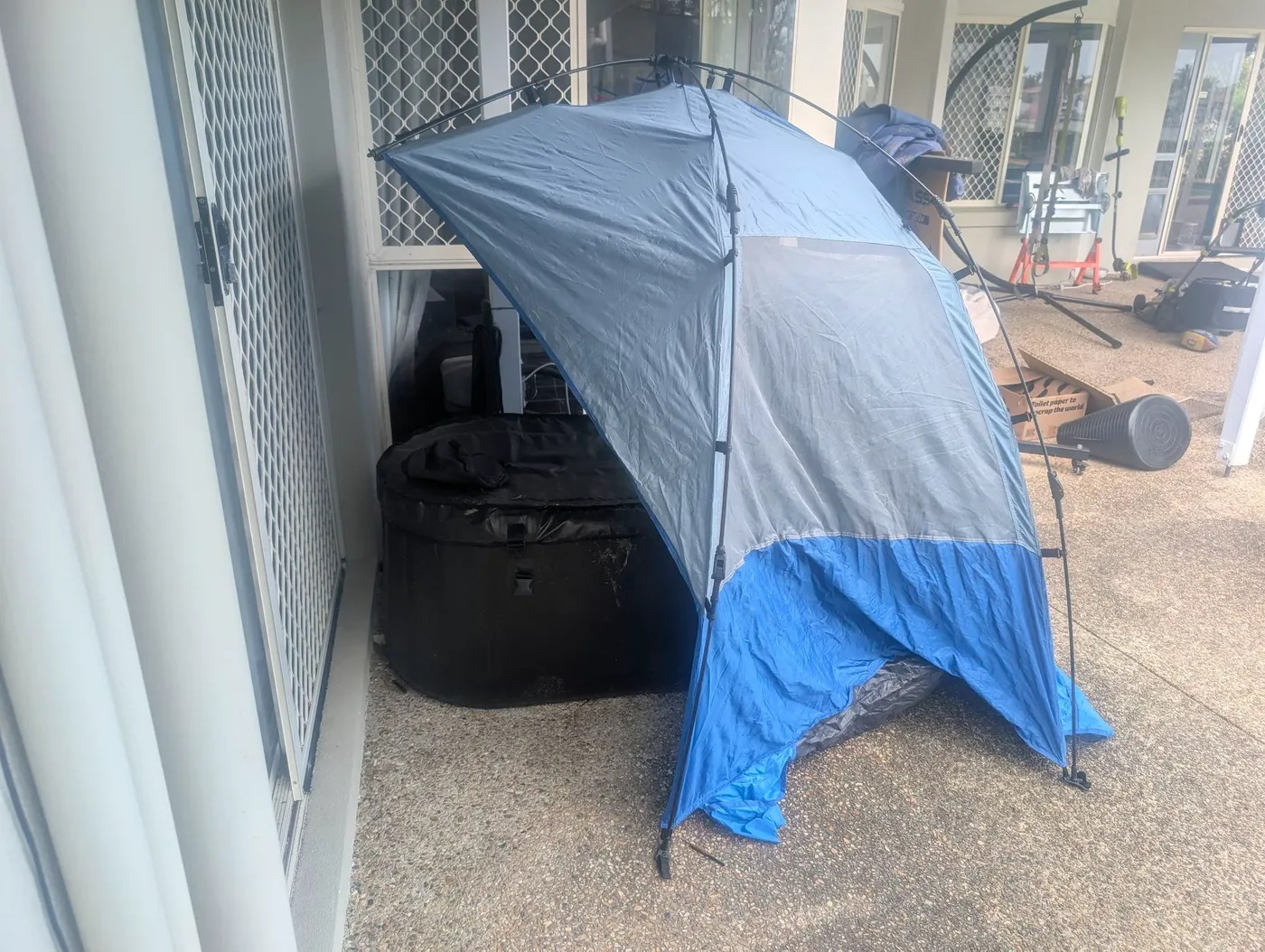
The fix, in its natural habitat. A year of logged data, a fitted thermal model, a Bureau of Meteorology forecast, and the thing actually standing between my ice bath and the afternoon sun is a beach shelter I last used in about 2019. The tub is the black drum tucked in behind it. The sun comes in low from the right, which is the entire point.
The photos raised two more problems:
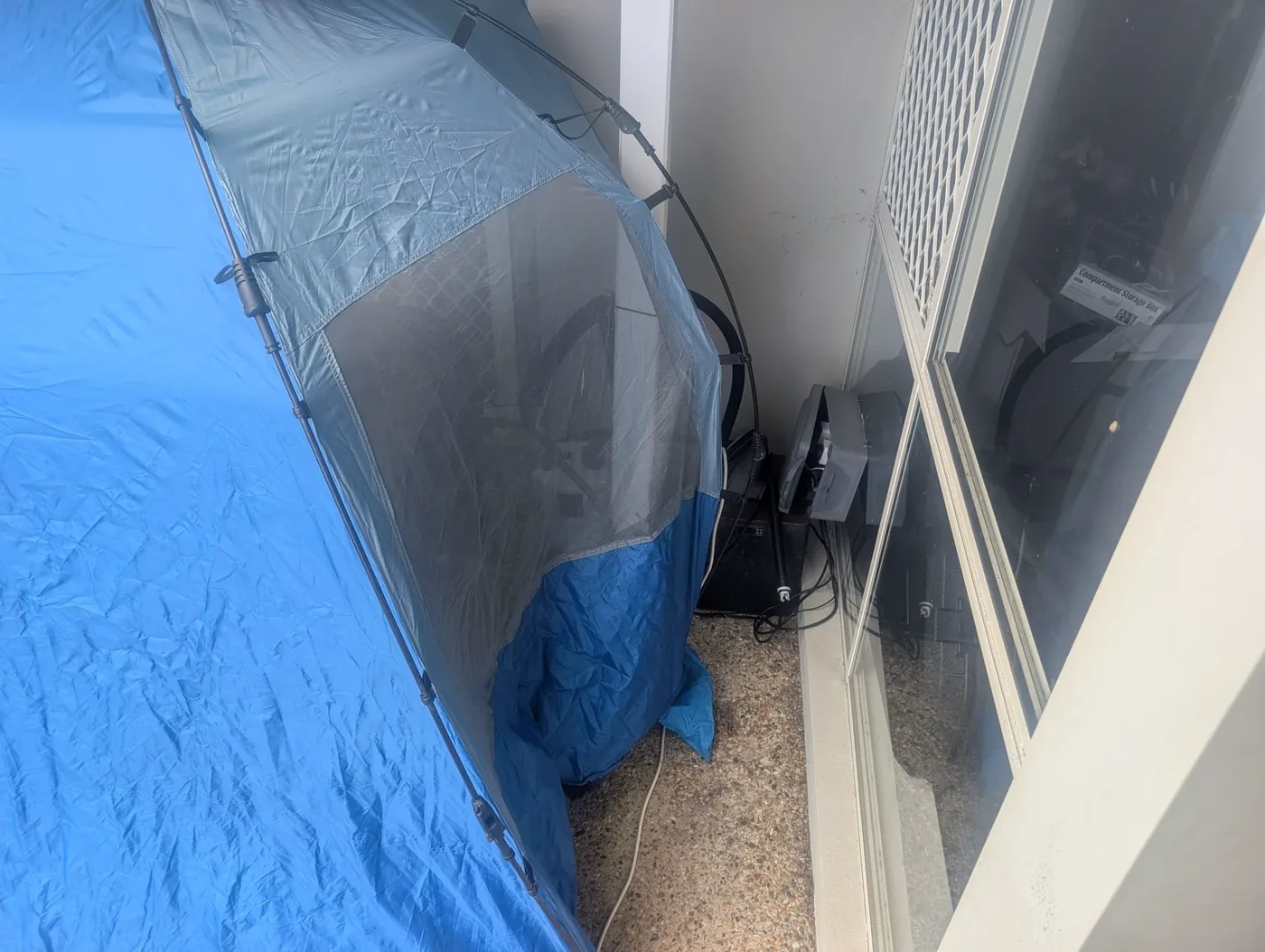
And here's the one I didn't see until I looked at the photo. The chiller is the black box in the corner, boxed in by a wall, a glass door, the tub, and now a tent. Everything it blows out has nowhere to go but back around to the tub.
- The chiller is now boxed in. It sits in the corner between a wall, a glass door and the tub, and the tent closed off the last open side. A chiller pushes hot air out the back. If it can't get away, the chiller breathes its own exhaust and gets less efficient, which could cancel out the shade. If that hot air blows onto the black tub wall, it's actively heating the bath. The fix is to keep the fabric well clear of wherever the warm air comes out. The tell-tale is the power draw: before the tent it drew 287 to 314 watts, so if it starts sitting up around 350 on similar days, it's re-breathing.
- The concrete is probably warming it from underneath. Even when the air and water are the same temperature, the bath still gains about 0.1°C an hour. The most likely source is the slab it sits on, pushing heat up through a thin PVC floor all night. A cheap foam mat underneath should help.
You can't schedule your way out of a heat leak. Fix the leak, then tune the pump.
And one more bug, found by the clouds
The overcast turned up one last surprise. With the solar flickering, the chiller was starting, stopping, and starting again two to six minutes later. Compressors hate that. They need a few minutes off for the pressures to settle before they restart, and every start wastes energy while it gets going.
I'd built in a 10-minute minimum to protect against exactly this. It turned out it only applied to stopping. Starting again was fair game. So:
# START pump + chiller - only after it has been OFF for the minimum cycle.
- conditions: "{{ want_on and not chiller_on and since_change > min_cycle_s }}"
Ten minutes off before it's allowed back on. The compressor sends its regards.
The rules I gave it
- Set a target it can actually reach. 4°C was never happening. 8°C is cold, achievable, and lets the thermostat actually switch off.
- Plan for the time you get in, not right now. The question is "will it be cold at 5:30", and Home Assistant now answers it with a number.
- Cost the power before you block it. Inefficient afternoon solar is still cheaper per degree than efficient overnight grid, because exported solar is worth almost nothing.
- Grid power only when it's cheap, and only when it's needed. The overnight 8c window, plus an opt-in late-evening top-up only if the forecast says it won't make it.
- The car still wins. If the EV wants the spare solar, the ice bath waits.
- Never chill blind. If the temperature sensor drops out, the chiller stays off.
- Give the compressor a break. Ten minutes minimum between stops and starts.
- Measure the fix. The before numbers are saved. After a few sunny afternoons under the tent, the data decides whether it worked, not my feelings.
The honest bit
The model is fitted to my tub, my lid, my chiller and my patio, using a weather station twenty kilometres away and a forecast that is, like all forecasts, a confident guess. Your numbers will be different. The method's the same: log everything, then ask the data before you ask the internet.
The forecast also assumes no more solar chilling for the rest of the day, so it errs on the warm side. If it says you're on track, you probably are.
The first real 5:30am test is tomorrow. The shade test needs a few sunny afternoons, which the sky has so far declined to provide. I'll report back. And yes, one of the Zigbee plugs failed to respond this morning, probably because the light switch it relays through has been dead for a month. Different automation. Different grumble.
The ice bath and I are back on speaking terms. Mostly it says "10.9", and I say "not good enough".
Update, three days later: the tent won
I promised to report back once the sky provided a few sunny afternoons. It did, grudgingly. The data is in, and I owe a second-hand beach shelter an apology for ever doubting it.
Same chiller, same code, same forecast. I split the logs at the moment the tent went up and compared the before with the after.
- The afternoon peak fell about four degrees. The bath used to cook straight back up to 17–18°C every day no matter what happened overnight. Under the tent it now tops out around 14. That is the whole ball game — the problem was always heat getting in, not the chiller failing to pull it out.
- It finally hit target. 7.9°C one morning, 7.0°C the next. Under 8°C, which it had never once managed. This post opened at a tragic 12.
- The "afternoon sun tax" I spent a week measuring has simply vanished. Before the tent, the bath leaked heat about 50% faster per degree in the afternoon than in the morning — that gap was the sun landing on a black tub. After the tent, the afternoon leaks no faster than the morning. Gone. Because of a tent.
The thing I was worried about — the chiller boxed into the corner, breathing its own exhaust — hasn't bitten. Its power draw is still sitting around 310 watts, exactly where it was before the tent, so it isn't choking on its own hot air yet. I'm still watching it, because I don't trust anything in this backyard.
Two honest asterisks. It's drawing a touch more power now — about 3.6–4 kWh a day instead of 2.5–3.3 — because it's actually holding a cold bath instead of giving up at 15 by lunchtime. That's the entire point, and it's mostly free solar and 8c overnight. And my clever forecast now lies to me: it still thinks the sun is cooking the tub, so it predicts the water warmer than it really comes out. It errs safe, but it's wrong, and it's owed a re-teach.
A month of decay curves, a Bureau of Meteorology feed and a fitted thermal model. The thing that actually fixed the ice bath was a tent and the humility to walk to the shed. The automation wasn't wasted — the cheap overnight run is what lands the water on target reliably — but the single biggest win had nothing to do with a line of YAML.
Mostly it used to say "10.9", and I'd say "not good enough". This morning it said 7.0, and I said nothing, because I was already in it.
Built for personal use, on my own gear, in my own backyard. Cold-water immersion isn't for everyone, so talk to a doctor before you climb into a tub of 8°C water at 5:30am for fun. Not affiliated with any chiller maker, weather bureau or camping shelter, all of whom would probably like their name kept out of this.
Get one of these — and a working automation — each week.
The builds, the bugs, and the YAML. No fluff.
Don't fancy the DIY?
Get Dycom Automation to do it properly.
Reading YAML isn't everyone's idea of a good night in. Dycom Automation — the grown-up, properly-insured version of all this — will design, install and tune your whole smart home for you. Same ruthless automations, none of the swearing.
Get it done by Dycom Automation →