
My Car Kept Locking Me Out, So I Made the House Knock on Its Door Every Hour
Smart key dead. App dead. Remote lock dead. Mechanical key, again. The dealer needs to see a fault that only shows up when nobody's looking, so the house now sends the car a lock command on a timer and writes down whether it answers. Two flat batteries, one mains charger and one suspiciously sunny pattern later, there are receipts. Full config included.
There's a small metal key hidden inside the EV9's key fob. Until October I didn't know it existed. Now I could find it in the dark, because I've had to use it more times than I'd like.
It goes like this. You walk up to the car. Nothing happens. You press unlock on the fob. Nothing. You open the Kia app and press unlock, and the app thinks about it for a minute and then says, very politely, that it sent the command but received no response. The car is sitting right there. It's just not talking to anyone.
The first time, in early October, it took roadside assistance to get me in. The dealer found a problem with the 12V battery's terminal clamp and with the battery itself, and replaced the clamp. The fault came back. I fitted a brand new 12V battery myself. The fault came back.
There's a word that turns up in every one of these stories, and it's intermittent. It's the natural predator of a warranty claim. I could already hear the phone call: "We had it here all day, mate, couldn't reproduce it."
So I decided to reproduce it. Constantly. With timestamps.
Knock, knock
The idea is simple. While the car is at home, parked and switched off, the house sends it a remote lock command on a timer, through the same cloud the Kia app uses. Then it writes down what happened. There are only three answers that matter:
- Worked. The car got the command and locked.
- Failed. The car got the command, answered, and refused. That's the interesting one.
- No response. Kia's server knocked and nobody came to the door.
Locking a car that's already locked barely does anything to it, which makes it the perfect thing to ask over and over. It's a polygraph question with no wrong answer, except silence.
Here's the knocker:
- alias: EV9 BCM Probe - Send Lock
  description: >-
    Every input_number.ev9_bcm_probe_interval minutes while the EV9 is home with the engine
    off, send a remote lock so sensor.ev9_bcm_probe records whether body control answers.
  triggers:
    - trigger: time_pattern
      minutes: /5
  conditions:
    - condition: state
      entity_id: input_boolean.ev9_bcm_probe
      state: "on"
    - condition: state
      entity_id: device_tracker.ev9_location
      state: home
    - condition: state
      entity_id: binary_sensor.ev9_engine
      state: "off"
    - condition: template
      value_template: >-
        {% set last = this.attributes.last_triggered %}
        {{ last is none or (now() - last).total_seconds()
           >= states('input_number.ev9_bcm_probe_interval') | float(30) * 60 - 60 }}
  actions:
    - action: lock.lock
      target:
        entity_id: lock.ev9_door_lock
      continue_on_error: true
  mode: single
It checks every five minutes but only fires once the interval has passed, so I can turn the interval up or down from the dashboard without touching YAML. There's a kill switch (input_boolean.ev9_bcm_probe), because at some point the car was going to be dead and the last thing it needed was me knocking on its forehead.
Then there are the two buttons I'm proudest of, because they're the least clever. On my phone: Fob PASS, Fob FAIL, App PASS, App FAIL. When I'm standing at the car, I press one. A person standing next to the thing with a key in their hand is the only sensor I fully trust.
Boss fight 1: the integration was throwing the answer in the bin
The car talks to Home Assistant through kia_uvo, a community integration that drives Kia's cloud. It's excellent. It's maintained for free by people who owe me nothing.
It also, it turns out, sends your lock command, waits for the car to say SUCCESS or FAILED or TIMEOUT, and then throws that answer away. You get "a lock command was sent". You don't get "and the car refused". For normal humans that's fine. For someone trying to catch a car in the act, it's the whole case.
So I patched it. A dozen lines in the integration's coordinator that fire an event with whatever the car said:
def _report_action_result(
    self, vehicle_id: str, action_id: str | None, action: str | None, status: Any, error: str | None = None
) -> None:
    """LOCAL PATCH: fire kia_uvo_action_result with what the car answered."""
    status = getattr(status, "value", status) or "UNKNOWN"
    if status != "SUCCESS":
        _LOGGER.warning(
            "Vehicle action '%s' (%s) finished with status %s %s",
            action, action_id, status, error or "",
        )
    self.hass.bus.async_fire(
        "kia_uvo_action_result",
        {"vehicle_id": vehicle_id, "action_id": action_id, "action": action,
         "status": status, "error": error},
    )
And on the Home Assistant side, a trigger-based template sensor that catches the event and stamps it with everything the car said at the time:
template:
  - triggers:
      - trigger: event
        event_type: kia_uvo_action_result
        event_data:
          action: lock vehicle
    sensor:
      - name: EV9 BCM Probe
        unique_id: ev9_bcm_probe_result
        icon: mdi:car-key
        state: >-
          {% from 'ev9.jinja' import ev9_status %}{{ ev9_status(trigger.event.data.status, trigger.event.data.error) }}
        attributes:
          checked_at: "{{ now().isoformat() }}"
          raw_status: "{{ trigger.event.data.status }}"
          error: "{{ trigger.event.data.error }}"
          soc: "{{ states('sensor.ev9_ev_battery_level') }}"
That little error attribute earned its keep later. Some "failures" turned out to be Kia's server saying your login has expired, which is a Home Assistant problem, not a car problem. If I'd lumped those in with the real ones, I'd have been lying to the dealer by accident.
Then an integration update quietly deleted my patch. Then the next one did too. So now there's a little script that re-applies the patch after every update, and it checks that every line it expects to find is still exactly where it expects it. If upstream has moved anything, the script stops and refuses rather than guessing. I've learnt not to trust a patch that probably applied.
Boss fight 2: the car lies about its own battery
The car reports its 12V battery to the cloud as a percentage, and for a while I took that number at face value. You can guess where this is going.
On 9 November the car was dead. Completely. No lights, nothing. The multimeter on the 12V terminals said 1.9 volts. The car's last report to the cloud said the 12V battery was at 87%.
Three days later it was dead again. 4.19 volts at the terminals. The car's last report said 95%. I recharged it from an external battery, it woke up, and its very first report said the 12V battery was at... 95%. From a battery I had just measured at four volts.
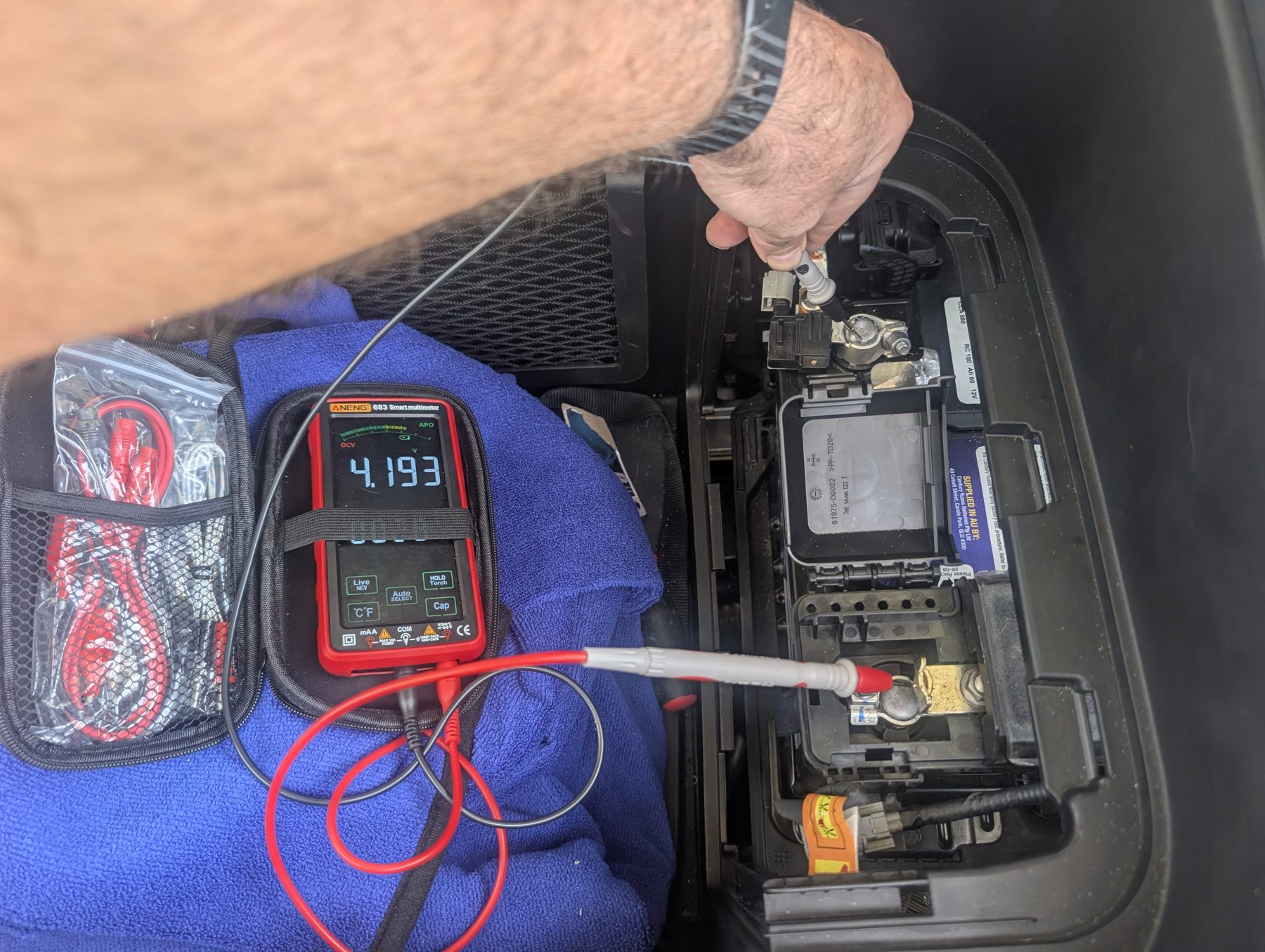
Once I went looking, the pattern was everywhere. When the fault starts, the 12V number freezes. It stays exactly where it was for hours, sometimes days, while the real battery does whatever it likes. Then the fault clears and the number jumps, sometimes by 30 points in one report. The figure on the dashboard wasn't a measurement. It was a photo of a measurement, taken whenever the car last felt like talking.
If the thing lies about itself, measure it with something that doesn't.
So now every real multimeter reading goes in the log, right next to the number the car claims.
Here's what two weeks of knocking looks like:
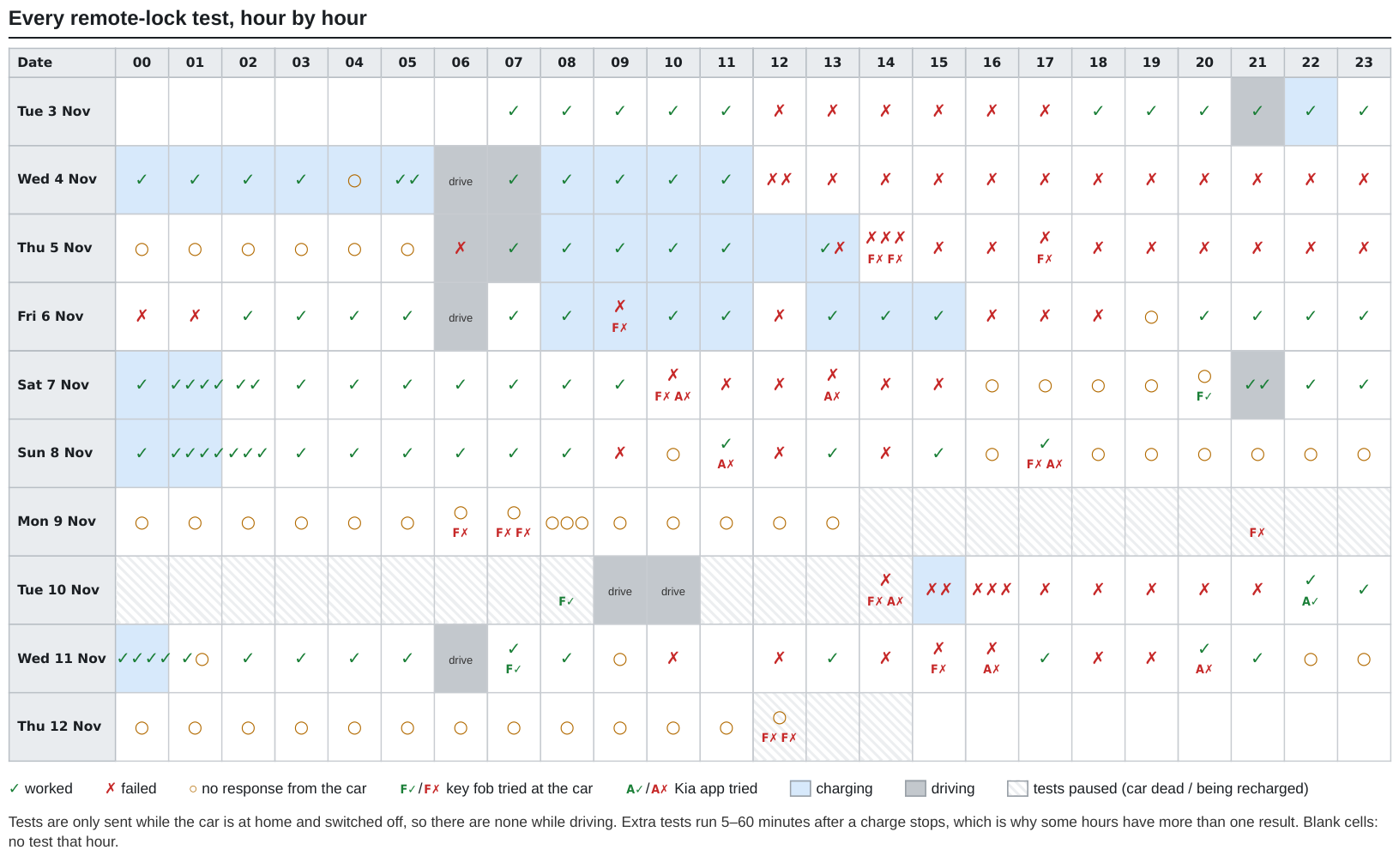
Green is the car answering. Red is the car answering and refusing. Orange circles are the car not answering at all. The hatched bits are where I stopped knocking because the car was dead and being recharged.
Don't diagnose. Document.
I have opinions about what's wrong with this car. Several. They change daily.
None of them went to the dealer. What went to the dealer was a PDF of facts: when each fault started, when it cleared, what the car was doing at the time, what the fob and app did, every test result hour by hour, the two times the car died and the voltage I measured. No theories, no "I reckon it's the...", no telling a qualified technician how to do their job. A timeline they can check against their own tools beats a theory they have to argue with.
There was one thing I did put in writing, because I could see it coming: "It's your logging that's flattening the battery." Fair question. So the PDF says it plainly. The fault started a month before I sent the car a single test command. The car also reports to the cloud on its own schedule, test or no test.
And here's the part I didn't love admitting to myself. Every test does wake the car up. While the hourly tests were running, the car checked in a lot more often than it did in October. The tests didn't start the fault, but I can't swear they never added to the drain. So the knocking went from every hour to every two hours, and I'm watching for any difference.
The control experiment
If a dying 12V battery is the cause, then a 12V battery that can't die should make the fault go away. So on a Friday morning the 12V went onto a mains battery charger, AGM setting, 10 amps maximum, and stayed there for 25 hours.
The charger ended up plugged in on the EV charger's circuit, which has its own power meter, and that turned out to be a lucky accident. The EV circuit's meter became a 12V current meter. When the car is asleep the charger trickles along at about 40 W. When a test wakes the car up, you can watch the car's load hit the 12V and the charger lunge to cover it:
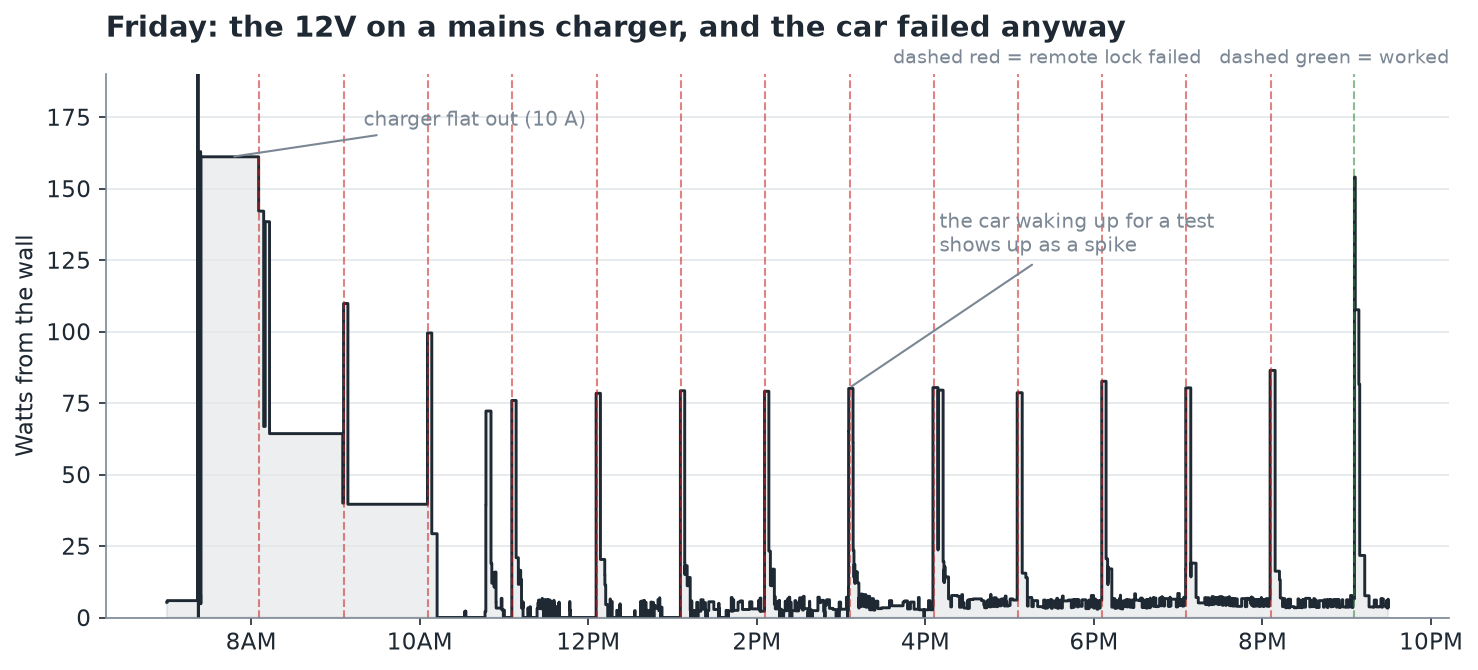
The battery was full. The charger was working. And from 8:05 in the morning until 9:05 at night, every single remote lock failed. The fob failed. The app failed. For three hours in the afternoon the car stopped talking to the cloud entirely. Then, at 9:05pm, it cleared up on its own, like nothing had happened.
At 4:10 that afternoon I opened the car's own health check in the Kia app. Nine systems. Eight green. One flagged:
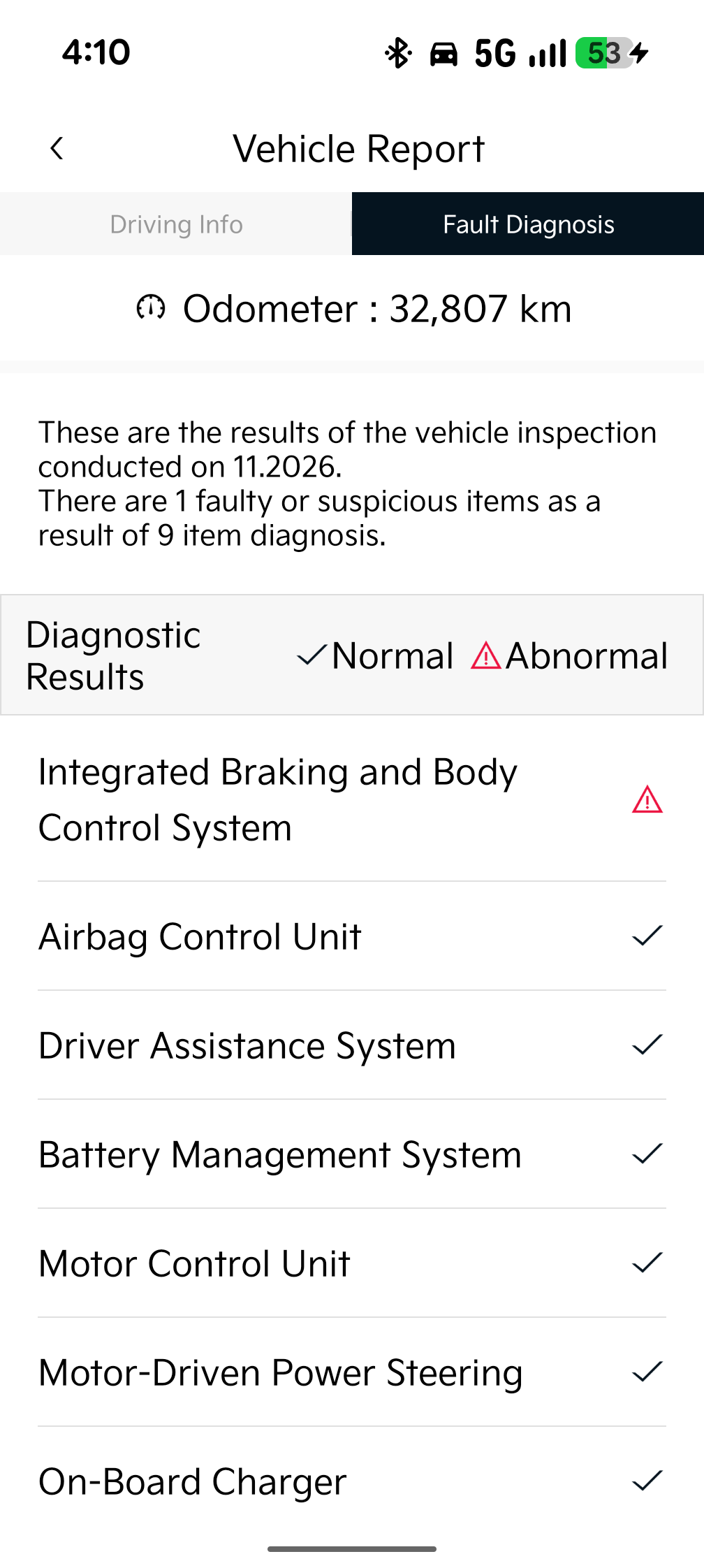
Integrated Braking and Body Control System: Abnormal. That's not my theory. That's the car's.
The sunshine theory
Long-time readers will remember the house charges this car from spare solar, turning the charge current up and down every few seconds to soak up exactly what the roof is exporting, and pausing the charge when a cloud wins.
So I went back through every fault start and asked one question: what had the charger just done?
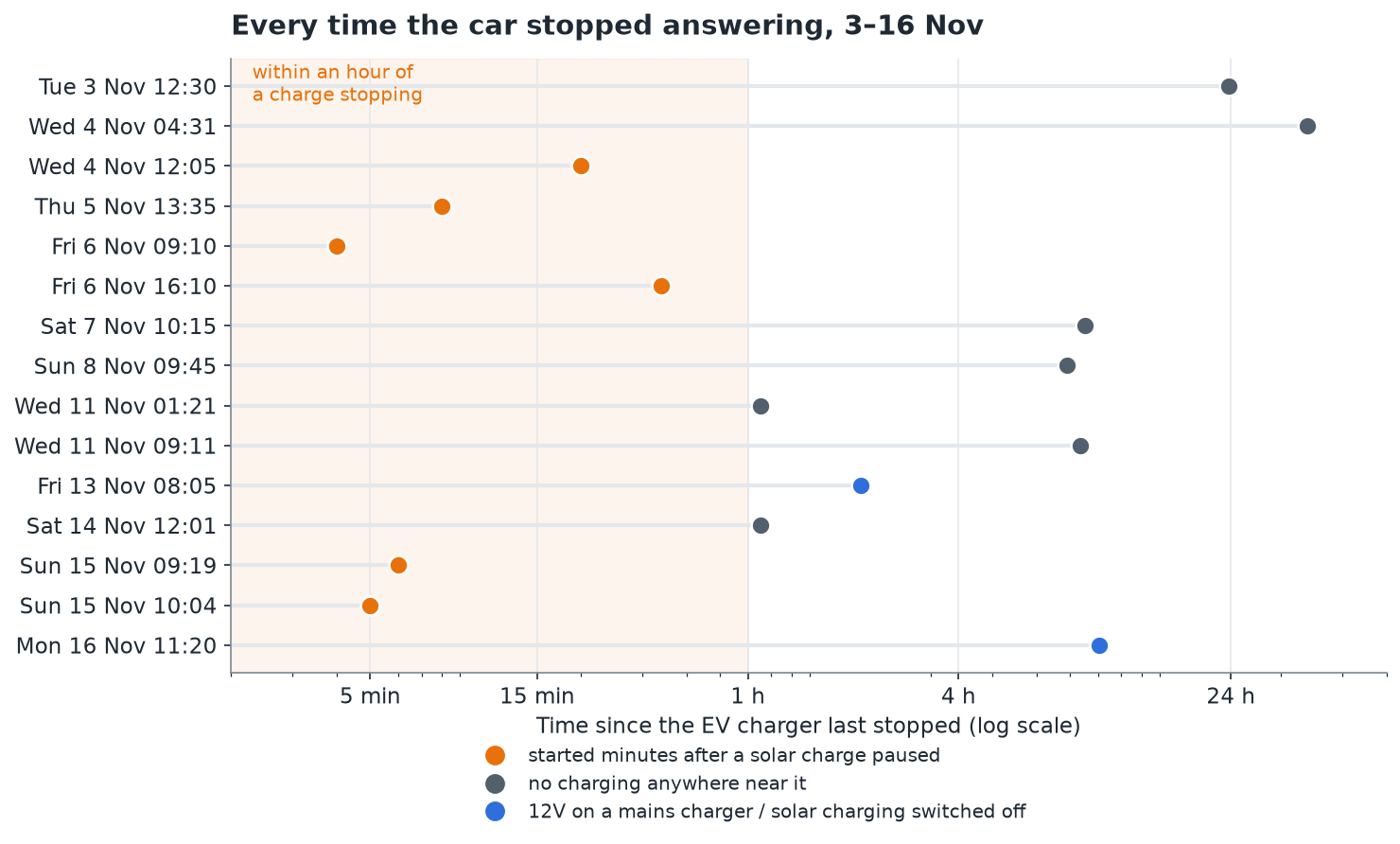
Five of the first twelve fault starts happened 4 to 34 minutes after a solar charge paused, all on stop-start days where the charger had already paused and resumed in the previous few hours. During daylight, a fault was about two and a half times as likely to start in the hour after a pause as at any other time. Then on a Sunday it happened twice in one morning: a solar pause, and five minutes later the car stopped answering.
Very suspicious. Also not the whole story. The other seven didn't line up with a solar pause, and a couple of them were in the small hours. Friday's all-day fault happened with the car unplugged and its 12V on a mains charger.
Correlation, meet causation. You two haven't been introduced.
So, an experiment. A week with no solar charging at all: off-peak only, a fixed 15 amps, one start and one stop a night. It's one new switch in the charging package, wired into the two places that decide whether solar is allowed to start or keep a charge going:
input_boolean:
  ev_solar_charging:
    name: EV Solar Charging (off = off-peak only, fixed amps)
    icon: mdi:solar-power-variant

# in the charging controller's variables:
solar_start: "{{ is_state('input_boolean.ev_solar_charging','on') and day and (not charging_now) and export_w >= surplus_w and is_state('binary_sensor.ev_solar_clear','on') }}"
solar_keep: "{{ is_state('input_boolean.ev_solar_charging','on') and day and charging_now and (raw_amps > min_a or import_w < stop_w) }}"
The same switch goes into the solar priority list, so the pool and the ice bath stop politely waiting for an EV that isn't coming.
The first result came in the next day, and it wasn't the one I wanted. The car faulted at 11:20 on a Monday morning. Unplugged. No charging for ten hours. No solar at all. The fob failed too.
So the sunshine theory has been demoted from the cause to a suspect. Stop-start charging looks like it makes the fault more likely to show up, and that fits with what other owners have seen. An Ioniq 5 owner (same platform underneath) reported the car logging an error and refusing to resume after a solar charger cut its power during a cloud, and the popular open-source solar charger evcc suggests a higher minimum current for some of these cars. Kia has also published several service bulletins for the EV9 about modules that don't go to sleep and quietly drain the 12V. Which, if any, apply to this car is a question for the dealer.
The week isn't over. I'll report back.
The car has a nagging limit
On Sunday afternoon the test results changed. Instead of failed, every test came back no response, all evening and overnight, even after the fob started working again. I was halfway into a new theory when the Kia app explained it for me:
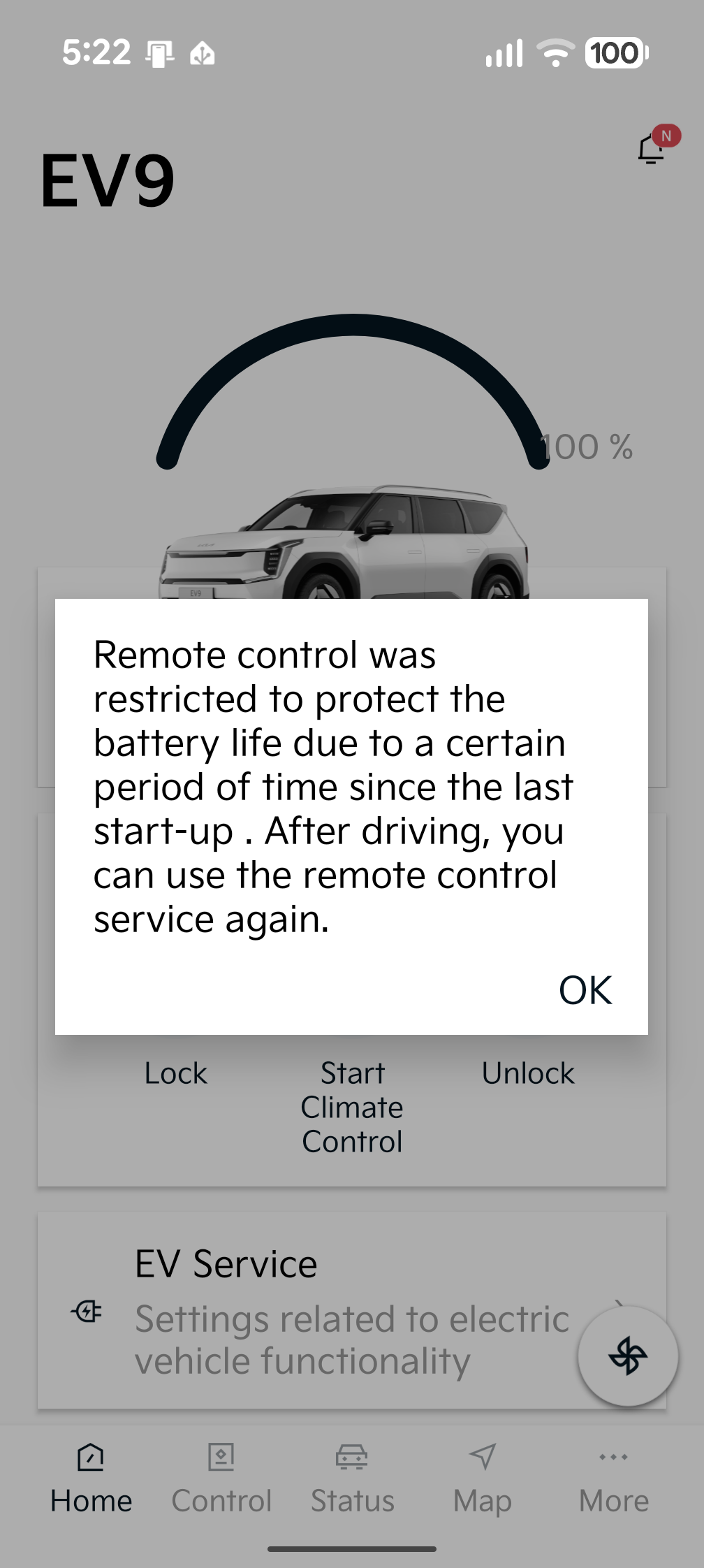
The car hadn't been driven for about a day, so it had stopped taking remote commands to protect its battery. Drive it, and remote control comes back. It did, at the first test after the morning run.
It's the first time a car has told me to stop pestering it, and it had a point. Those hours are now logged separately from the real fault, and the knocking is down to every two hours.
The rules I gave it
- Only knock when the car is home, parked and switched off. Never while it's being driven. Never while it's somewhere else.
- Record the answer, not my guess. Failed, no response and your login expired are three different problems, and only one of them is the car's fault.
- A person at the car outranks every sensor. The fob and app buttons are the ground truth. Everything else is supporting evidence.
- When the car is dead, stop knocking. Nobody needs a probe hammering a flat battery.
- When the car says it's being pestered, back off. It has a limit. Respect it.
- Facts go to the mechanic. Theories go on the blog.
- Every integration update gets re-patched, or the script refuses. No probably applied.
The honest bit
The car integration is a community project that talks to Kia's cloud through an API Kia doesn't support for this. My patch is a local hack, not something the maintainers asked for, and they deserve nothing but gratitude for the rest of it. This is personal-use tinkering, and the API could change tomorrow.
Every test is a real command to a real car, and it wakes the car up. My logging is a participant here, not a neutral observer, and I've tried to be upfront about that everywhere it matters, including to the dealer.
I'm not a Kia technician. Nothing in this post is a diagnosis. The dealer has the diagnostic tools and the factory information, and the fix is their job. My job was to make sure the fault couldn't hide when they went looking for it. The car is booked in, and a follow-up full of new timestamps is on its way.
The EV9 still does its day job as the DyComDrive car, which is exactly why a car that sometimes won't let its driver in is not a hobby problem. The mechanical key now lives in my pocket instead of the fob. The house still knocks every two hours. And the next time the car doesn't answer the door, there'll be a timestamp, a voltage and a reason not to say "couldn't reproduce".
Disclaimer: this is one car, one household, one community integration and one cloud API that could change without notice. If your car won't unlock, call roadside assistance, not a YAML file. Don't send remote commands to a car you're not prepared to wake up, and leave anything under the bonnet that isn't the 12V battery to a qualified technician.
Get one of these — and a working automation — each week.
The builds, the bugs, and the YAML. No fluff.
Don't fancy the DIY?
Get Dycom Automation to do it properly.
Reading YAML isn't everyone's idea of a good night in. Dycom Automation — the grown-up, properly-insured version of all this — will design, install and tune your whole smart home for you. Same ruthless automations, none of the swearing.
Get it done by Dycom Automation →